Showing posts with label Burlock. Show all posts

Saturday, June 13, 2015

Samuel Muholland: The Family Patriarch

Samuel Mulholland was born in Ireland. He married Jane Bullock. They came to the United States and settled in Superior Township, Washtenaw County, Michigan in 1833 where their son Sam jr. had settled several years earlier. At least nine individuals can be identified as their children: Sam jr, William, Phebe, Sarah, Jane, Eliza, and MaryAnn. Two older brothers, John and James Mulholland, are known to be sons of Sam sr. from Probate Records. Given the gaps in ages between the children of Sam sr, there may have been additional children as yet unidentified or perhaps the marriage to Jane was a second or third marriage.

Sam sr. was a farmer and purchased land in the township and beyond. An 1840 deed between sons James and John describing bounding land indicates Sam Sr was living in Dixboro on a town plot previously owned by James. Land records signed by Sam and wife Jane from 1845 indicate both were alive at that date. Sam sr. appears in Probate Records for his son John in 1846. By 1850, Samuel sr. and Jane had died or at least disappeared from any further records. And that is about all that we can be sure of. The records from this early period of rural Michigan are sparse, and from contacts made with Ireland, there seems to be little there either.

Earlier genealogies have linked every Mulholland in Superior Township in the early years directly to the patriarch Samuel, but the evidence that that all these Mulhollands were his offspring is more a convenience than a reality. In fact, some of these links seem odd because such a single family tree ends up with multiple Janes, MaryAnns and Phebes in the same root family, an unlikely naming scheme even for Irish families where names are reused.

The Stories versus the Documents: Ireland to Michigan


One of the problems with tracing the families is the issue of the spelling of names—most of these immigrants were not literate, and there were inconsistent ways of spelling, partly due to the individual not being set on a particular spelling and partly because those doing the recording didn't get it right either. While my family ended up with Mulholland in most later generations, there are a few possible relatives who now have Mulhollen or Mollholand and other variants. 

1833 Tithe Book for Aghabog
The other problem is the lack of early records for the area of Ireland from which they emigrated. Records from Drumhirk, Aghabog, County Monaghan where Sam jr is known to have originated give a Samuel Mulholland in the Tithe Applotment Book of 1833 living on 7 acres in the area but there is not enough to be certain this is the same Samuel in our story. The location matches the naturalization records for his sons James, John, and Samuel who arrived in Michigan earlier. Church records for the area are only available beginning in 1856, long after our Mulhollands had left.

The known story comes from the 1881 History of Washtenaw County, where Samuel and Jane are mentioned in the biographies of both sons, Sam jr and William. Of course, the hints that there might be a problem with these two stories is obvious immediately, since Jane is listed as having the surname Bullock in the former and Burlock in the latter, even though the two bios are on the same page! Bullock appears in more records than Burlock, is known as a family name from the area where the Mulhollands originated in Ireland, with one family living within two miles of Drumhirk, and is therefore used in this narrative as the best guess for Jane's surname.

There is no further mention of Samuel and Jane in Sam jr's biography, but William's indicates he arrived with his family, presumably including his parents, in 1835, after Sam jr who arrived in 1831. However, the date for immigration in the 1881 History is not correct, as the family was already there in 1833 based on other records (possibly a typo as in handwriting, 35 could be misread for 33).

Several records suggest an earlier arrival by fall 1833, including a land purchase by Sam in Section 20 of Superior Township from his sons James and John in October 1833. Phebe married in September 1833. Sam jr and William signed a petition for road improvements in January 1834 sent to the U.S. Congress in February of that year. Further, the extended "Sam'l Mulhollan" family appears in the 1834 Michigan census enumerated in mid-1834, showing it was a large Irish household living in Superior Township. Unfortunately, the census has only gender and age ranges, lacking the individual names or more detailed locations found in later census enumerations. It does show that the males were engaged in agriculture.

The Samuel Mulholland Household in Superior Township


Part of the 1834 Census, Superior Township
A reasonable assumption based on the 1834 Michigan census is that the senior Samuel Mulholland is the male 50-60, his wife Jane Bullock Mulholland is the female 40-50, and two of the older sons are Sam and William. The rest of the household of eight includes another male and three younger females. From other records, Sam and William had three younger sisters who are documented and are the likely females: Jane Mulholland (Stebbins), Eliza Mulholland Larabee, and MaryAnn Mulholland but that leaves one male yet unidentified. Given that many of these early households had servants or farm hands as well as other relatives, the unidentified man may not even be a sibling to the five known children. Son James and a second male of about the same age are listed separately in the 1834 census. Other records suggest John initially lived with James and his wife until John married in 1835.

Like many women of the time, Jane Bullock Mulholland does not appear in any of the usual official documents. Her presence is mostly assumed as the older female in the census records. Her birth, marriage, and death dates are unknown. She does appear in deed records in May 1845 when son William purchased land from his parents in Section 17 of Superior Township where he farmed most of his life. No tombstone has been found for her and it is possible she was buried on their farmland, as the first Dixboro church did not appear until 1857. In fact, William purchased land for a family grave in 1858 on land that had belonged to brother James before a sheriff sale, making it likely that family members were buried there until the opening of Oak Grove Cemetery near Dixboro where later family are buried.

Samuel Mulholland can be found in several official records. Samuel registered an original purchase of land in Ingham County in 1836 with his sons, Sam jr. and William although the land patent was not issued by the U.S. land bureau until 1837. None of the Mulhollands lived there; this land was sold off with proceeds supporting the family and helping to fund farmland in Superior Township.

In the 1840 U.S. census, there is a similar large household as in 1834 with only gender and ages listed under the Samuel Mulholland family. None of the four known children had married by this time and presumably are still living with their parents. Based on this assumption, the older male 50-59 is Samuel, Jane is now listed between 50-59, and the two males between 20-29 are Sam jr. and William. The household has more females than it did in 1834, with 4 listed but only three known offspring: Jane, Eliza and MaryAnn. One of the males, probably the unknown one, from 1834 is gone. Samuel is among the list of males 21 and older in the 1845 Michigan census in which there are two Samuels listed, making one the father and the other the son.

The children of Samuel sr. are all living separately by the 1850 census, with the youngest, MaryAnn living next to William with another a younger Mulholland girl who at 16 and born in Ireland, could not be a sister nor would she have arrived in Michigan in 1833 as did the rest of the family. William, Sam jr, Jane and Eliza are married with their own families.

With no record of Sam sr by 1850, it can be assumed he had died by that date and after the last known record in 1846. Like his wife Jane, Samuel's burial place is unknown. Based on the census records, which may not be right, Samuel would have been born between 1781 and 1784, with Jane about 1785 if John and James are her oldest sons.  It is likely they had a large family like many other Irish couples of the time but only some of the children are certain. One can only hope that new records will emerge to help solve the mysteries of Samuel Mulholland sr. and Jane Bullock.
updated 25 April 2026

Monday, April 20, 2015

The Dixboro Ghost, Part 3: Are We Related?

Every child in the family who hears the Dixboro Ghost story asks the same question, knowing we have Mulholland ancestors from Washtenaw County: "Are we related?" It would be such a thrill to be able to claim to have your great-great something who was a ghost and then get to tell this creepy story to your young and impressionable friends.

The Dixboro Ghost
from The Detroit News, 1930
The Ann Arbor Mulhollands of Chapin Street who were my grandparents and great-aunties said the John and James Mulholland in the story were in the family but we are not direct descendants.

Only one document shows the relationship to the family story. In Probate Court records from 1846, Samuel Mulholland sr indicated he was the father of John, and that Sam jr and William were his sons and John's brothers. With James a documented brother of John, the "villain" of the story is also in our family.

Even for these nearer but now-dead aunties, the ghost tale was in the distant past. They did not know about the incident directly and didn't really have much better knowledge than we do now--in fact may have had even less. Most of their knowledge came not from their great-somethings (if others knew, they were too embarrassed to talk about the scandal), but from the 1881 History of Washtenaw County, since the family owned a copy. Research done by a local historian in the 1963 examining court records and newspapers from the time show even the story in the 1881 History, a mere 35 years after events, was already distorted. And the official testimony in the ghost inquest in 1846, a year after Martha's death, was contradictory.

All in the Family (sort of)


While part of the family, no children are known today who are the offspring of James and John Mulholland. The ghost herself, Martha Crawford Mulholland, had only one child from her marriage to John Mulholland, but their child died in 1840 just after his father. Probate records from 1846 state John "had no children living." Martha had a child from her first marriage, Joseph Crawford. He has descendants but they are not related to the Mulhollands. Unless they come forward, her antagonist, James Mulholland's four children are unknown to us after his wife Emily Loomis died and the family left Superior Township. The census of 1840 indicates five children, one a male and four daughters..

We are descended from Samuel Mulholland sr and his son, Samuel Mulholland jr, who were the father and brother of John and James in Dixboro. So the grandmas and aunties had it right that the Ghost story characters are not our ancestors but are firmly in the family tree.

The birthdates of 1802 for John and 1804 for James known from their naturalization documents and census records make them much older than the other known children of Sam sr. Even with large Irish families and big age spreads, a twenty-six year difference between youngest and oldest is uncommon. The eight-year gap between James and Sam jr. suggests there may be other unknown children, or perhaps Jane was a second marriage so that Sam sr. had a family by an earlier wife. Some additional Mulhollands appear in early Washtenaw County who may be related, but they typically appear in only a single document or are part of the Steele Mulholland family that landed in Ann Arbor about 1840, and who our elderly relatives insisted are not related to us. DNA evidence links us to individuals still in the area of Ireland that the Mulhollands came from, but there are no early records to show how we may be connected.

Thus some of the tree has open questions as records for the early Michigan territory are mostly lost or never existed, we lack old family artifacts like an ancient bible, and had word from researchers in County Monaghan in Ireland that records before the mid-nineteenth century are also limited or never were kept (our family was Protestant, therefore not as carefully documented as were those in the old World whose vital records were recorded by the Catholic Church). Without better records, the mystery of the family relationships may never be fully known but this provides a challenge to continue looking just in case.

Footnote on other Michigan Mulhollands:

Several other Mulholland families emerge in the research about our family in Michigan in the the early nineteenth century:
  1. Anyone who has lived in Ann Arbor knows there is a Mulholland Street south of downtown. The bad news for us Mulhollands is that our grandmas and aunties assured us we were not related to them. Steele Mulholland, who came some years after our Superior Mulhollands and settled in Ann Arbor where the street runs, was known to have come from a different part of Ireland. We don't get to claim relationship to the street.
  2. A second family of interest is the Daniel Mulhollen family of Monroe, Michigan. Like our Superior Mulhollands, this is a large family descended from Irish immigrants. As documents show, our families used varied spellings of the name over time, and they settled on Mulhollen while we went with Mulholland. Family trees for Daniel, who arrived in Michigan about 1804, show that he came from Antrim, where there are indeed many Mulhollands but we know our family came from County Monaghan. Minimally, given the pattern of land buying by Daniel, the similar naming pattern for the children, and their location in Michigan before our relatives, there is likely some connection and inspiration for what our relatives did here. It would not be surprising to find there is a family link to Daniel and family to our Mulhollands but it would go back to Ireland where the records don't exist for our family. And to date, there are no DNA ties to that family.
  3. A rather unusual link to the ghost tale comes through land purchases in Illinois by William H. Mulholland and Henry Mulholland of Washtenaw in 1847. In 1847, this William purchased tracts of land in Nauvoo, also partnering with Ruben Loomis. Nauvoo is well known as a stopping place for the Latter Day Saints, who were driven from the town and forced to sell their property at this time, leading to the settling of Salt Lake City. Land speculators moved in to buy up tracts in Nauvoo when the Mormon community was forced to sell.  A real question is whether William H is the same as our William, as none of the sons of Samuel used a middle initial in any document known from our Washtenaw family. The relationship of Henry to the Washtenaw Mulhollands is unknown, but he had been buying land in the area before the sell off. Reuben Loomis is probably related to Emily Loomis, the second wife of James Mulholland in the ghost story. A James H. Mulholland also ends up in the Nauvoo land purchases (not the famous Mormon James however). This James ends up convicted of counterfeiting. Here’s hoping that is not the James from our ghost story! Our James was in Michigan in mid-1847 but reported to be in Illinois in 1848 according to court records. The specific reference to Washtenaw makes some association likely but it is improbable that William H and James H are the same as our family although an intriguing hypothesis is that one of these could be the son of James known only as a tic mark in the 1830 and 1840 Washtenaw census.
updated 20 April 2026

Sunday, April 19, 2015

The Dixboro Ghost, Part 2: A Genealogical Retelling

Of course, the kind of records used in genealogy have very little to say about the realities of ghosts, and after so many years, about the possibilities of poison or dead bodies deposited (or not) in local wells. But even without the dramatic touch of the Dixboro Ghost (see Part 1), the story of John Mulholland and James Mulholland is an interesting one.

Their story begins some years before Martha Crawford, the supposed Dixboro ghost, appears on the scene from Canada. In its broad sweep, it is about a large Irish family that immigrated to the United States from County Monaghan. While there are a lot of Mulhollands and an equal number of tales, for this one the focus is on James Mulholland, the first to arrive in Washtenaw County, Michigan Territory about 1826; in 1829 he first appears in county court records. His slightly older brother John came in 1831, having traveled from Ireland through Canada to Michigan. Their immigration dates and homeland are documented in 1834 court records of their "declaration of intent" to become naturalized citizens. Younger brother Sam arrived with John but is not part of the ghost legend.

Buying Original Land Patents in the Michigan Territory


The Michigan territory as it was known back then was intended to be used for homesteads as a reward to those who fought in the war of 1812, but with rumors spread that it was a land of swamps and disease—possibly by early settlers who didn't want to see a land rush around their scenic new farms—few veterans took up the offer. In 1820, legislation opened the land for purchase by anyone with the cash to buy, and slowly over the next decades the land was sold off, with the more southern parts going first.

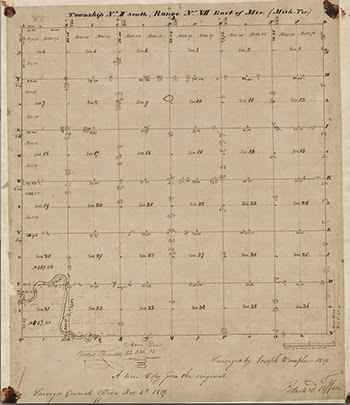
Original U.S. survey of Superior Township, Michigan, 1819
Purchasing homestead land was not an easy process, and even back then the bureaucracy could make buying a long and complicated task. The government had done official surveys of Michigan, laying out counties in neat squares and subdividing these into parcels within townships described by geographical references rather than names which made up the areas available for sale. Even today the remnants of the early land division and sales can be seen in the square fields and straight tree lines bordering rural farms still defined by the early survey. 

Once a person had sufficient cash to purchase a parcel, he had to get a survey done based on the government township borders, be sure the parcel was not already sold, take the survey and cash to the land office that had the authority to make the sale, register a cash receipt, then wait for the land patent to arrive from far-away Washington DC. The patent next had to be registered with the local officials so the land could be put into the usual circulation of sale and inheritance through deeds. In the case of Washtenaw County, the land office was in Detroit, a good distance for these early settlers when they had to travel on horseback and without many roads or inns along the way, and cash was something that few farmers had to spare.

According to the 1881 History of Washtenaw County, the Mulhollands were a family of weavers in Ireland, but their professions shifted to farming and other trades after arriving in the U.S. James and John Mulholland worked diligently to earn money to buy the kind of large farms not attainable in their homeland. By 1832, the brothers obtained their first land patent for 80 acres in Section 18 of Superior County, the same section in which Captain James Dix, the founder of Dixboro, bought in that year. In 1835, after more of the family had arrived from Ireland, James purchased another 40 acres in Section 20, a parcel which was sold to his father Sam sr. and where my great-great grandfather Samuel Mulholland jr later farmed. The description of this latter property looked like this, rather arcane for those who are not surveyors or deed writers:

Sw 1/4 of the Nw 1/4 of Section 20 in township 2 South of Range 7 East [Superior] in the District of lands subject to sale at Detroit Michigan Territory containing 40 acres (Land patent, certificate 8030, issued 9 Oct 1835, to James Mulhollan of Washtenaw County Michigan Territory)

John and James had continued to buy homestead property in Michigan, expanding beyond Washtenaw and picking up large parcels in Livingston and Ingham counties in 1837. In a history of Livingston county, it was pointed out that the Mulhollands never lived on their homestead but sold it off for a profit in the following two years. 

The patents show John and James held all but the Section 20 lands in common not in joint tenancy. Just prior to his death and in failing health, court records show John arranged for a division of the land held by himself and his brother. While John attempted to get his estate in order before his death, he was unable to get all in place.

With John's death in June 1840, Martha became the administrator of John's estate under Probate Court order to produce an appraisal of "goods, chattels, rights, and credits" in 1840. When the estate had not been appraised, James went back to the Probate Court in 1841 indicating that it needed to be done and that there were debts to be settled and he was the primary creditor. The court ordered a $1000 bond to bring in appraisers, but in 1842 Martha herself indicated she was not able to comply due to failing health, and requested that the court appoint a new administrator to review the estate. Despite continued claims and counterclaims, the estate remained unsettled until 1846, when John's father Sam sr. petitioned the courts to appoint his sons Sam jr and William, John's younger brothers, as administrators. In the petition dated 19 Jan 1846, Sam was sworn as stating:

The undersigned Samuel Mulholland would represent that he is the Father of John Mulholland late of Superior in said county deceased that said John Mulholland died at Superior aforesaid sometime in June in the year AD 1840 intestate leaving real and personal property to be administered. The undersigned further represent that the said deceased has no children now living and that it is necessary that some person or persons should be appointed to settle the estate of said deceased as there are debts to be collected and paid. The undersigned would waive his right to administer said estate on account of his extreme old age and requests you to appoint Samuel Mulholland jr and William Mulholland brothers of said deceased and sons of your petitioner administrators for said estate upon their [young hand?] for the faithful discharge of that trust. 

With Martha's death in 1845, eventually most of John's remaining estate formally went to his stepson Joseph Crawford, Martha's son from her first marriage as there was no will. If James felt some resentment for Martha's teenage son, not even a member of the Mulholland family, inheriting the land and money he had worked so hard to attain with brother John, and likely had further plans to exploit, it would not be a surprise.

Growing Township, Growing Families


Interestingly, the ghost story has little to say about family life, perhaps because this makes the players more human and less ominous. While relationships among James and Martha were perhaps strained, the participants in the ghost story had much broader lives.


A view of Dixboro, Michigan from the Commons in 2004

James left Ireland and immigrated to Quebec, Canada in 1826 and before 1829 was living in Washtenaw, Michigan. He was an early settler in Dixboro founded by John Dix. In county civil court records from November 1829, James appeared in the court with Dix for an indictment of $50 owed to the United States. The indictment does not indicate the reason for the assessment but it must have been paid, as the two were released on their own recognizance and ordered to pay up or appear at the next court session. They do not appear again at the next court session.

The exact date that James married his first wife, Ann Mulholland, is unknown as is her maiden name, although some reports indicate she came with him to Michigan. By the time of the 1830 census of Panama Township, later divided into Superior and Salem Townships as we know them today, James is listed as living with a woman (most likely his wife Ann) between the ages of 20 and 30, about the same age as her husband, and with a son under five. In 1834, the household had grown to five with the addition of another adult male, presumably brother John who immigrated in 1831, and a daughter under 5. These early census records did not have names for any but the head of household. As a result, the names of most of James' children have been lost to us unless new records are discovered. Only one son of James is known from a sad story of a toddler who got too close to the fireplace and burned to death when his clothes caught fire. James jr. died after his mother Ann, living from 1835 to 1838.

Martha Crawford and son were not listed as living with her sister Ann's family in mid-1834 when the census data was recorded. She is reported to have arrived in mid-1835 from the later court hearings related to her enigmatic death. John and Martha were married in December 1835 when John was 33. When John died in 1840, he left behind a son reportedly born in 1836 but who died later in the same year as his father.

James remarried to Emily Loomis in 1838 after Ann's death about 1836-7, all before John then Martha died. While the ghost story claimed James and his second wife had only one stillborn child, in fact they had at least two more children. Further, he and his family did not flee immediately after the 1846 inquest, nor were any criminal charges ever filed against him. In an interesting vignette reported in a Universalist Church publication in 1847, Emily Loomis Mulholland's death is noted, indicating the family remained in Superior Township: 

Death. In Superior, on Ap 25 last [1847], Mrs. Emily, wife of Mr. James Mulholland, in the 34th year of her age. She has left a husband and four small children, the youngest about four weeks old, also an aged Father and Mother, to mourn the loss of a faithful child and virtuous Mother. She has been a member of the Universalist Church in Ann Arbor about nine years. (published Dec 1847, The Expounder of Primitive Christianity, v. 4, p. 175)

By 1850, only Martha's son, Joseph Crawford, remained in Superior Township of all the characters from the Dixboro Ghost Story. He retained his inheritances, with the records showing he owned property worth $1000. Joseph married in 1855, and by 1870 he too had left Superior Township, moving initially north in Michigan to Livingston County where other Mulhollands had settled, and later to Ogemaw where he became one of those revered early settlers, dying shortly after his move there.


Mounting Problems for James Mulholland


For James Muholland, the evidence suggests his departure from Superior Township after the ghost inquest may have been as much about finding a wife or caretaker for his four orphaned young children rather than any guilt over what happened to his sister-in-law. He did not flee immediately as has been recorded in legend but did eventually move on, and over time, community sentiment eased after the initial hysteria brought on by the wild tales of Martha's ghost and perhaps gossip by a few who didn't like James. Whether the community feud also rendered family ties to his father and siblings is unknown, but Sam jr. did testify to the Probate Court in 1846 that there were unpaid liens on John's estate, perhaps providing some evidence the family was sympathetic to James's complaints.

Debts may also have contributed to the disappearance of James as suggested in earlier histories. His lands were seized by the courts for unpaid debts with lawsuits as early as 1846. His land in Section 19 of Superior was sold at a public auction in late 1849 for debts owed by James, his brother-in-law William Loomis, and David Bottsford, another original land owner in Washtenaw County. In court postings, James was reported to no longer be in Michigan in November 1848, with his location reported as Illinois.

James debt problems continued to mount. Frederick Townsend petitioned for redress in the Detroit courts in February 1850 and as a result James' two remaining lots in Dixboro were seized by the sheriff of Washtenaw County. With no creditors coming forward after 15 months, the lots were auctioned at a sheriff sale in fall 1852. Townsend was allowed, rather conveniently, to purchase the two village lots owned by James for $100, far below the actual value. As history has since recorded, based on Michigan laws at the time, this process of land seizure and repurchase was a corrupt one in which a debtor could collect and profit with little evidence and often few others being aware of the court orders and sale.

The ending of the recorded ghost story stating it is uncertain where James Mulholland went remains true, as neither he nor his children have been located in official records after Emily's death in 1847 and with the loss of his property in 1850. He may have relocated with his family to Illinois but no records have been found that clearly are our James there (the name is common enough and there is little evidence that in known documents that one of the multiple James are this one).

For more on the story and early Mulhollands in Superior Township, see Dixboro Ghost, Part 3
updated 20 April 2026